June 18, 2026
Copier Maintenance Agreement Questions to Ask Before You Sign
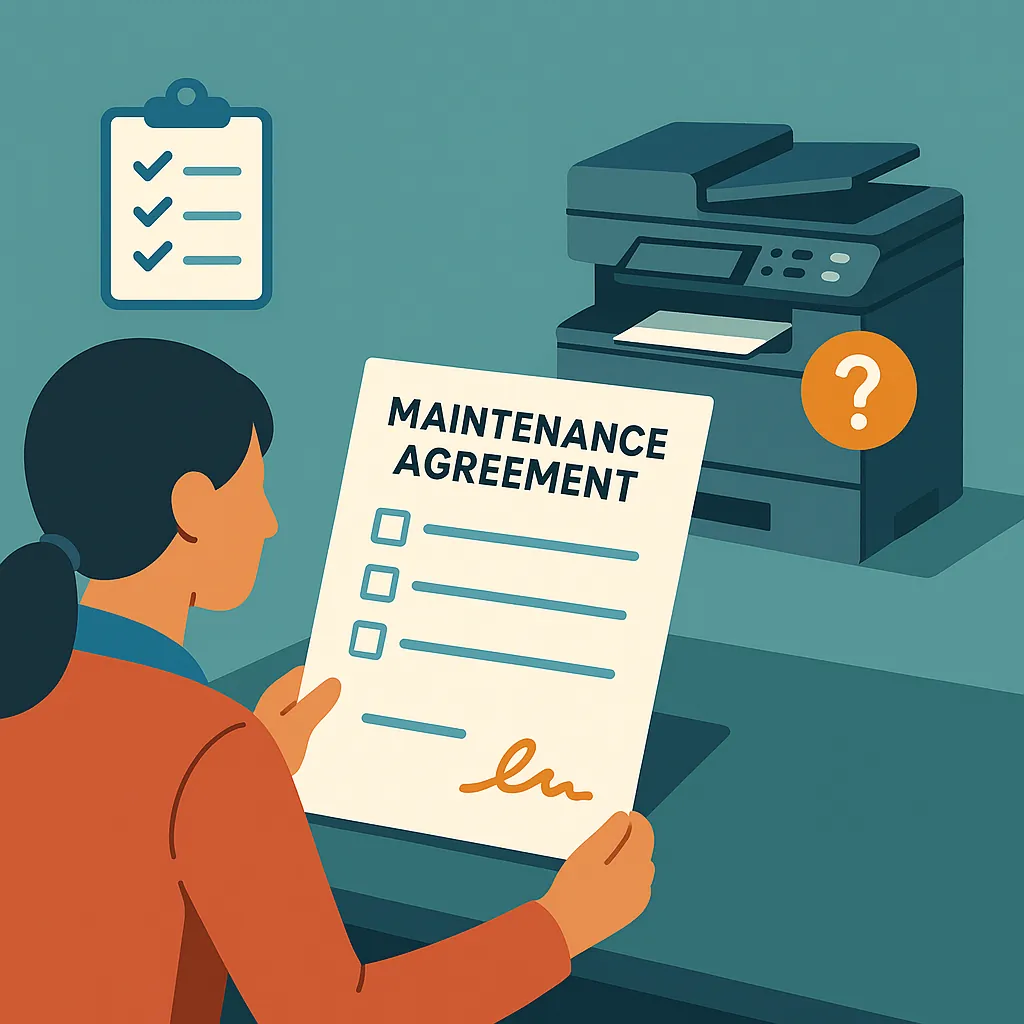
An office manager at a nonprofit called us earlier this year with a Sharp MX3571 and no active problems. She was putting together information for a board presentation and wanted to understand what a maintenance relationship actually looks like before anything went wrong. A few weeks before that, a print shop owner called with three Xerox machines slowly aging off their OEM service contracts and one already down on the floor. Different situations, same underlying question: what does it cost to keep a commercial copier running, and how do I know if the provider I'm talking to actually knows what they're doing?
If you're reading this before a breakdown, you're doing this right. The copier maintenance agreement questions to ask are much easier to raise — and answer honestly — when nothing is currently on fire.
Why Shopping Before the Breakdown Is the Right Move
High-volume copiers degrade quickly, especially under commercial workloads. That's not a scare tactic, it's mechanics. Components wear against page count, and a machine that's behind on maintenance doesn't announce it politely before failing.
There are two situations where proactive shoppers typically call us. The first is an office that already owns a machine and is setting up a service relationship for the first time. The second is a business watching an OEM manufacturer age out service contracts on older equipment and looking for a third-party copier service contract to step in. Both situations benefit from the same thing: talking to someone who will evaluate before quoting.
What Actually Triggers a Maintenance Visit and Why It Matters for Pricing
This is the part most generic articles skip, and it's the part that tells you fastest whether a provider knows what they're doing.
Maintenance on a commercial copier is tied to page count, not a calendar. We call it unscheduled scheduled maintenance. The service intervals are predictable. At 100,000 pages, certain components need to be replaced. The calendar date those intervals fall on is not predictable, because page volume varies by office. A machine running 500 to 800 pages a week and a machine running that same volume per day will hit the same PM intervals at very different times.
A provider who does not ask about your monthly or weekly page volume before quoting a contract is not pricing it accurately. Volume is the input. Without it, whatever number they give you is a guess.
Here is what a full PM service on a color machine like the Sharp MX3571 actually involves: four drum unit repair kits (one per color channel, running approximately $60 to $90 each depending on model), a transfer belt assembly cleaning kit, and paper feed roller service. That's not a short visit. Extensive maintenance on that machine runs one and a half to two hours. A normal service call for adjustments or targeted component work is 45 minutes to an hour.
On a properly structured annual maintenance agreement, we plan for roughly three service calls per year and install components at the right page-count intervals. The goal is to eliminate unplanned emergency calls, not just respond to them.
Read the Machine Before You Sign Anything
No maintenance contract can be accurately quoted without a physical evaluation of the machine's current meter count and condition. This matters for the provider and for you.
The meter count report is readable directly from the machine's control panel. It tells the technician exactly where the machine stands relative to its next PM kit interval. Without it, any quote is built on assumptions, and assumptions get corrected later through service disputes or unanticipated charges.
Symptoms your staff may have been ignoring are also worth discussing before a contract is priced. Lines in print output and recurring paper jams are not random bad luck. On a color machine, lines are typically related to drum unit wear across one or more of the four color drums, transfer belt cleaning kit condition, or components that have passed their service interval. Repeated jams often point to paper feed roller degradation. A provider who asks about these symptoms during a pre-contract conversation is doing preliminary diagnosis. That's what you want.
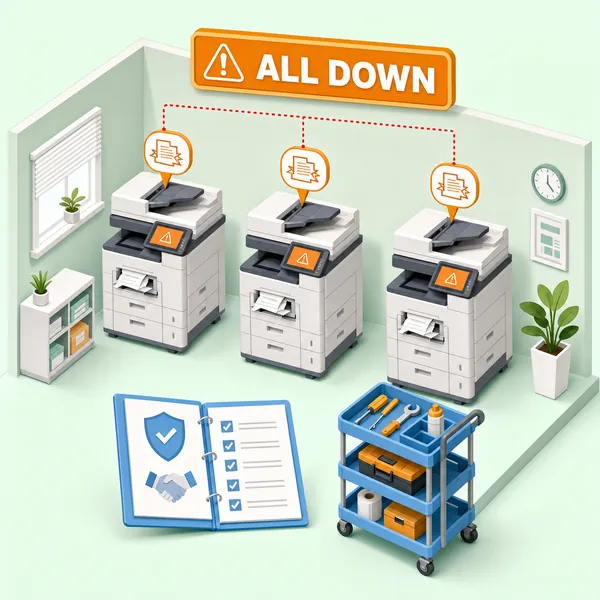
When the print shop owner called with the Xerox IR-120 already faulted, we asked for a photo of the error code sent by text so we could run remote diagnostics before rolling a technician. Arriving prepared is faster and cheaper for everyone.
DataPrint provides free on-site estimates before quoting any copier maintenance agreement in Los Angeles. The visit is to evaluate the machine's actual condition and meter count. We won't quote a contract without it.
Copier Maintenance Agreement Questions to Ask Before You Sign
The checklist below is grounded in the mechanics and operational reality covered above, not a generic industry template.
Does the provider ask about your page volume before quoting? If not, the price is a guess. Volume drives maintenance frequency, which drives cost.
What specific components are covered at PM intervals, and which are billed separately? On color machines, the high-frequency wear items are drum unit kits, transfer belt cleaning kits, and feed rollers. Get that list in writing before you agree to anything.
What is the labor rate, and what is the minimum charge? Our rate is $175 per hour with a one-hour minimum on any attempted repair. Knowing the time-and-material rate upfront is how you compare that option against a flat contract. When the nonprofit manager needed to present options to her board, we put that rate in writing so she could walk in with real numbers.
Is there a contract length commitment, or can service be done on a time-and-material basis? Both are legitimate options. A low-volume office running 500 to 800 pages a week may not need a full annual agreement. A high-volume production environment with aging equipment probably does. The honest answer depends on your situation, and a provider who only offers one structure without explaining the other isn't giving you the full picture.
If your equipment is aging off an OEM contract, does the third-party copier service contract provider have parts access for older models? This is the specific position the print shop was in with Xerox. A third-party dealer can step in and take over service on equipment that a manufacturer stops supporting, but only if they actually stock or can source the parts. Ask directly.
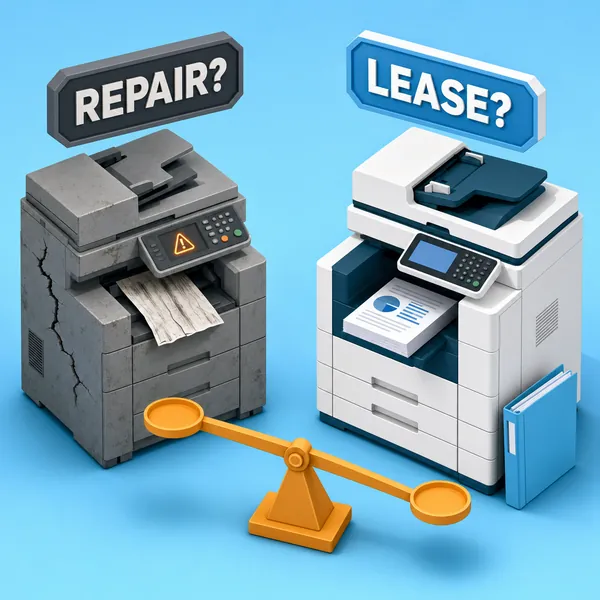
At what point does it stop making sense to repair an aging machine, and will the provider say so honestly? That is a weighted ROI question. Throwing a couple thousand dollars into a machine that's going to need increasing attention is a different calculation than putting a few hundred dollars a month toward a maintenance-included lease on something newer. A provider who is only interested in selling you repairs won't frame it that way. One who's interested in your business long-term will.
Two additional questions worth raising with any provider, though the answers vary across the industry: ask whether the contract specifies a response time commitment, because same-day, next business day, and best-effort are meaningfully different in a production environment. Also confirm whether IT-related issues like network connectivity, print drivers, or scanning to email are included or excluded. Most service contracts exclude these explicitly.
Contract vs. Time-and-Material: Which One Fits Your Situation
Most of DataPrint's business, roughly 80% by the owner's characterization, runs on maintenance-included programs. That's the structure we're built around. But time-and-material service is a real option, and we present it honestly when it fits.
For a low-volume office, a full annual maintenance agreement may be more than the situation calls for. If the machine isn't hitting major PM intervals frequently, paying for a structured contract when on-call service would cost less isn't the right call for the customer.
For high-volume commercial equipment aging off an OEM contract, the math usually runs the other direction. Machines that have been running hard are going to need increasing attention. Per-incident repair costs on equipment that's due for multiple PM items add up fast. A maintenance-included agreement that plans for those intervals is typically the more predictable option, and predictable cost is the point.
Both customers who called us were doing the same thing: trying to avoid being caught flat-footed. One needed board-ready numbers on a machine with no current issues. The other needed a provider ready to step in before Xerox walked away from his equipment entirely.
What both needed first was an honest evaluation, not a contract proposal. If you're in either of those positions, we offer free on-site estimates across Greater Los Angeles before any agreement is quoted. We come to you, read the machine, and tell you what it actually needs. From there, you decide what structure makes sense.