August 19, 2026
Copier Repair Service Los Angeles: Why Clients Stay 10–25 Years
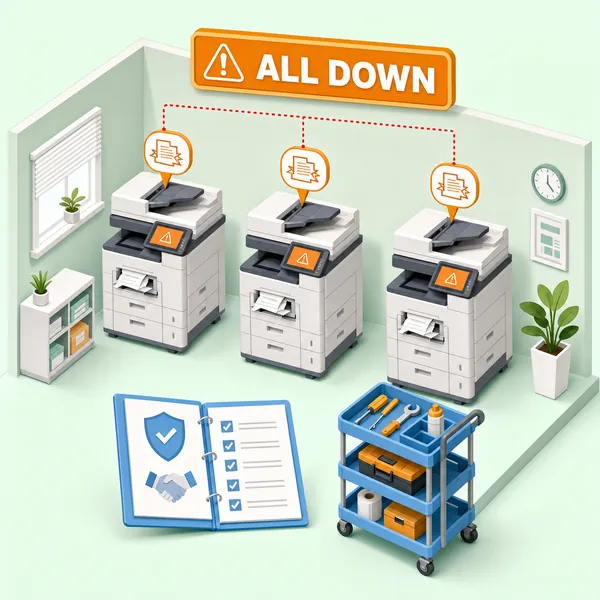
You've been through this before. A new service company answers fast, shows up on time for the first call, and seems like the right fit. Then six months later you're leaving voicemails no one returns, or a tech shows up who has never seen your machine and clearly has no idea where to start. You switch again. The cycle repeats.
If you're evaluating a copier repair service in Los Angeles right now, you already know that "experience" and "fast response" appear on every vendor's website. What most vendors can't show you is whether anyone has actually stayed.
25 Years Is Not an Accident
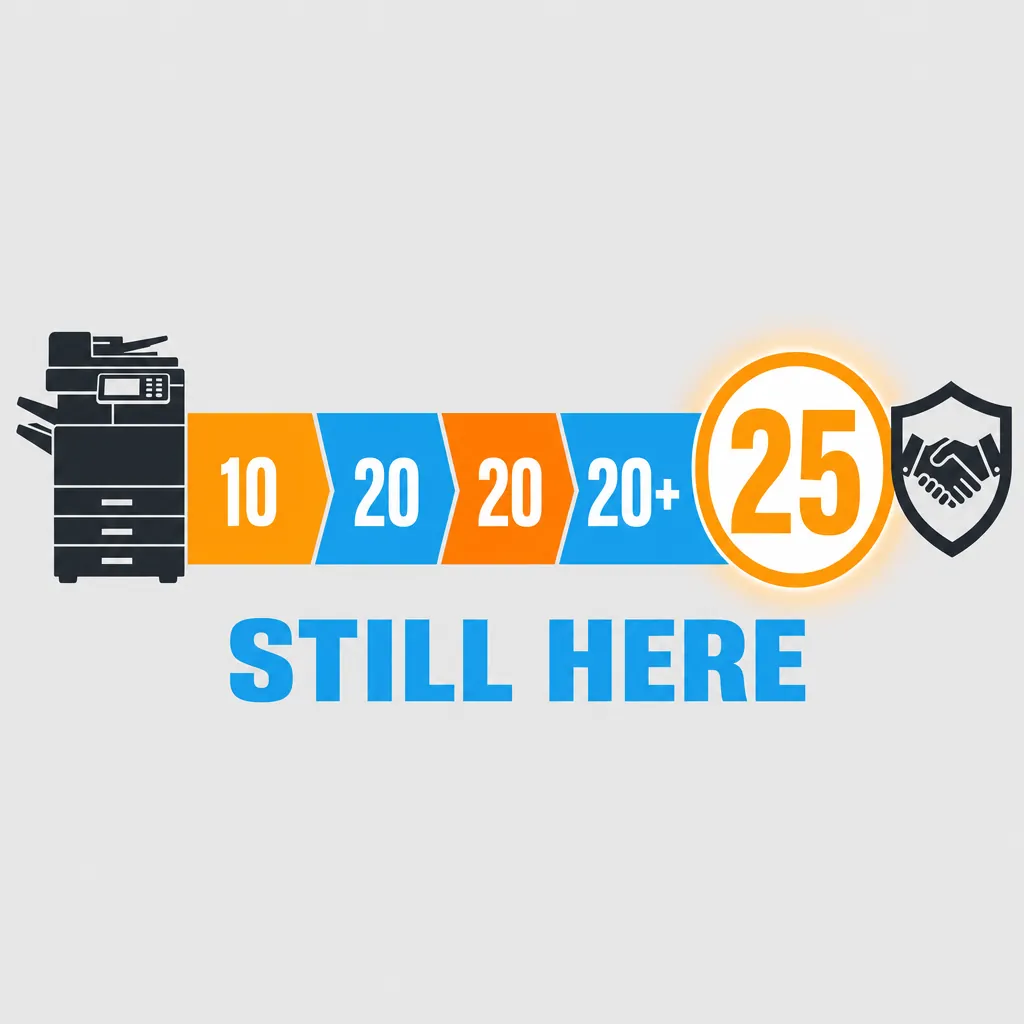
Five independent clients have each said, in their own words, that they've been with DataPrint for 10, 20, 20, 20+, and 25 years. Not one long relationship — five separate ones, across different industries and different points in the company's history.
The 25-year relationship is with a Los Angeles law firm. They've used DataPrint to provide and maintain their office copiers and printers for the entire span. As one reviewer from that firm put it, their response time is "no more than an hour," and they described the relationship plainly: "Without DataPrint Solutions we would simply close the doors."
DataPrint has been operating out of Van Nuys since 1988. These relationships were built, one service call at a time, and they held.
Five clients. Five independent decisions to stay. That's a pattern.
What Keeps a Business From Switching After a Decade
The honest answer is: no reason to leave. That sounds simple, but it requires consistent behavior over years, not just a strong first impression.
A litigation support firm that has been a client for over 20 years attributes it directly to responsiveness and attentiveness, noting that "our machines are always humming" and that the color print quality handles trial prep and file handling without issue. For that kind of business, downtime is not an inconvenience. It's a billing problem.
A small family business with 20+ years in the relationship put it this way: even as a small account, the team "placed great importance on meeting all our needs" and combined that service level with pricing that stayed affordable. That combination is harder to find than it sounds.
One behavior that comes up repeatedly is honest repair-vs-replace guidance. When a client asked for an assessment on a color printer that was struggling, our team walked through the cost of a repair against the cost of a new machine and made it clear that buying new was the better answer. That kind of advice means not making a sale. It also means the client trusts you the next time they have a question.
And some relationships start in a crisis. One business reached out cold, desperate after their copier failed completely. A replacement rental unit arrived the same day. That was over a decade ago. The machine has been running without complaint ever since, and they've stayed a client through all of it.
What Mission-Critical Uptime Actually Means
"Reliable service" is easy to say. The stakes vary enormously depending on what you're printing and how often.
For the law firm mentioned above, the copier is not a convenience. It's a practice-sustaining piece of infrastructure. Without it functioning, the office doesn't function. That's not an exaggeration on their part — it's a straightforward statement of operational reality.
A restaurant and catering company in West LA runs a large Sharp copier to print invoices, menus, and catering orders, "literally everything," as they described it. Daily. That machine going down doesn't just create a hassle; it creates a gap in operations that touches customers immediately.
The scale of what DataPrint handles has always included high-volume environments. In the 1990s, documented client correspondence confirmed multi-year service relationships maintaining fleets of more than 20 machines for a large aerospace and defense manufacturing client. Those letters specifically cited fast emergency response on high-volume equipment as a reason for the ongoing relationship. That's not a casual service arrangement.
When an office manager at a cold storage company in the San Fernando Valley called because their Xerox VersaLink multifunction unit clicked and stopped printing entirely, a machine handling roughly 2,000 pages of daily compliance printing, same-day service was scheduled. That's the environment DataPrint is built for.
How a Reliable Copier Service Company Diagnoses Problems Long-Term
One call illustrates the approach well. A business owner in the Los Angeles area reached out about a Sharp MX-3070 stuck in a boot loop. A previous technician had pointed to the formatter board as the likely culprit, a diagnosis that would have meant a significant repair bill. Our assessment went in a different direction: toner levels that had never been replaced over years of use were identified as a probable root cause. Before recommending any expensive component replacement, the plan was to inspect the drum units, address the depleted cartridges, and see if the boot issue resolved.
That kind of discipline matters over a long relationship. It means you're not paying for repairs that don't fix anything.
Preventive maintenance works the same way. Rather than scheduling service on a calendar, DataPrint uses page count as the trigger, what we call "unscheduled scheduled maintenance." On Sharp MX series machines, certain components need attention at roughly 100,000-page intervals. When a machine hits that threshold, the work gets done. When it hasn't, it doesn't.
On a Xerox VersaLink that was still showing a toner alert after a cartridge replacement and printing with smudging, the first diagnostic question was whether the replacement was an OEM Xerox cartridge or a compatible. That's not a minor detail. The answer shapes the entire diagnostic path.
And before quoting any copier maintenance contract in Los Angeles, we require a free on-site visit first. The meter count matters. The machine's condition matters. A contract quoted without seeing the machine isn't worth much to anyone.
What a Long-Term Service Partner Looks Like vs. a One-Call Vendor
Here's a straightforward framework for evaluating any local printer repair company in Los Angeles, DataPrint included.
When you call a local, owner-operated business, the person who answers has direct technical knowledge of the machines and knows your account. There's no call center creating a ticket that gets routed to a dispatcher who schedules a technician who has never heard of you. The knowledge is there from the first conversation.
After a service visit, the relationship doesn't end when the technician leaves. One client asked about home-use color printer options during a service call. After returning to the office, our team emailed a detailed list of highly-rated machines matched to that specific situation. That's not a sales pitch. It's follow-through.
Maintenance agreements at DataPrint are structured around roughly three planned service calls per year, with components installed at page-count intervals to eliminate as many unplanned calls as possible. The goal is that you never have to call because something broke.
On rentals, there are no long-term contracts required with our short-term rentals. That structure puts the performance pressure on DataPrint, not on the customer. If the service isn't worth keeping, you're not locked in.
In a service industry with genuinely high vendor turnover, multi-decade client retention across five independent relationships is a meaningful signal. It's difficult to sustain across that many clients, across that many years, without consistently doing the work right.
Still Here After 35 Years — For Whatever Comes Next
DataPrint Solutions has served Greater Los Angeles from Van Nuys since 1988, covering the San Fernando Valley, West LA, South Bay, Downtown LA, Burbank, Glendale, Pasadena, Santa Monica, and Long Beach. Services include copier and printer repair, maintenance contracts, leasing, rental, and sales across Canon, Ricoh, Konica Minolta, Kyocera, Sharp, Brother, HP, and Xerox equipment.
If you're evaluating a service partner, the first step is a free on-site estimate. No obligation, no contract required to start the conversation. The 35-year track record speaks for itself. The first call is just how you find out if it applies to your situation.