July 28, 2026
When Your Copier Manufacturer Service Contract Ends

You call the manufacturer for toner. Or for a service tech. And the person on the other end tells you the machine is end-of-life — they no longer support it, and there is nothing they can do for you. If you are lucky, you find this out before the machine goes down. Most businesses find out the same week something breaks.
This is one of those transition moments that almost nobody plans for, and it happens to plenty of businesses in Los Angeles. We have been handling copier service since 1988, and the calls we get from business owners in this situation almost always share the same pattern: they were caught off guard, they are not sure what options are real, and they need a straight answer without a sales pitch attached.
This post is that straight answer.
What 'End of Manufacturer Service' Actually Means
When a manufacturer declares a model end-of-life or end-of-service, most businesses assume that means slower support or longer wait times. That is not what it means.
Once a model hits its end-of-service date, the manufacturer no longer provides support or repairs, and they do not guarantee availability for ordering parts, supplies, or consumables for that model. Drivers, firmware documentation, and technical support are removed from official channels as well. It is a complete wind-down, not a gradual slowdown.
Most manufacturers plan a 5-to-7-year support window before phasing out active production of supplies, parts, and updates. After that window closes, the supply chain behind your machine closes with it.
In April 2026, a business owner reached out to us about a copier that had been introduced roughly twelve years prior. He had called the manufacturer looking for toner and been told they no longer made it. We ran a live lookup across our primary parts suppliers: no toner, no drum units, no maintenance kits. Nothing available through professional channels. When a machine has aged off its service contract with no parts available, the supply is simply gone.
The Warning Signs Your Machine Is Getting Close
The transition off a manufacturer contract rarely arrives without warning. The signs are there if you know what to look for.
Service contract renewal costs are one of the clearest signals. As equipment ages, renewal prices typically increase each year because manufacturers factor in higher expected service frequency and the growing difficulty of sourcing parts for older models. If your contract cost has been climbing at renewal time, that is a reflection of where the machine is in its lifecycle.
The more telling sign is what the machine itself is doing. High-volume commercial copiers do not age the way most people expect. The decline is not linear. A machine that has been reliable for eight years can deteriorate quickly once it crosses a certain threshold of wear.
One customer put it to us plainly during a service call: dogs, fax machines, and copiers all age exponentially. That observation holds up. We hear versions of it regularly from business owners who were surprised by how fast a machine went from reliable to problematic.
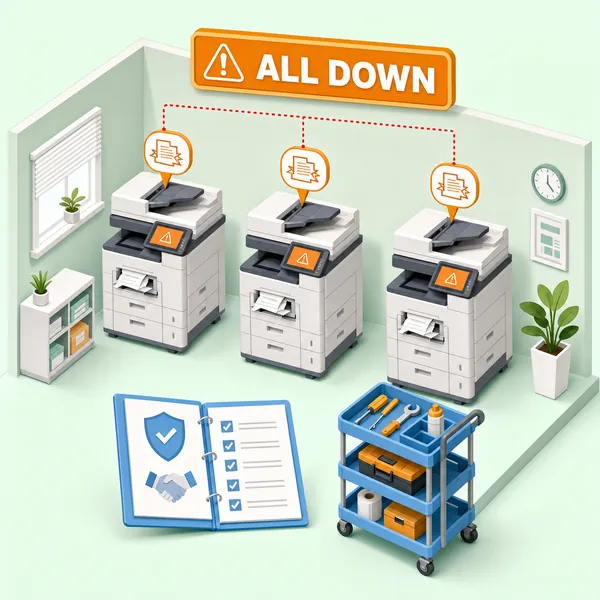
Another caller contacted us because three machines were aging off their service contracts and he needed someone to step in. While we were still on the phone, one of the units faulted live. The machine was still nominally under coverage, but it was already failing before the contract lapsed. That is the more common scenario than people realize: the machine does not wait for the contract end date to start having problems.
How a Third-Party Provider Evaluates Your Equipment
When a business calls us about aging equipment, the first thing we do is not schedule a truck. We run a remote evaluation before anyone gets in a car.
With one print shop caller, I asked for the vintage of each machine, their monthly page volume, and whether they buy paper by the case or by the pallet. That last question is not casual conversation. How you buy paper is one of the most reliable cross-checks on a stated volume estimate. It tells you whether the number someone quotes you reflects what the machines actually produce.
I also asked for photos of the model number tags and the active fault code on the machine that had just gone down so I could run diagnostics before the onsite visit. That step saves time on both sides and means the estimate I give when I walk in is grounded in something real, not guesswork. Estimates themselves are always free.
I started in this industry 35 years ago working for a major manufacturer directly before founding DataPrint. That history matters when you are evaluating aging production equipment, not because of brand loyalty, but because I know exactly how these machines are built, how they degrade under production loads, and what a fault code is actually telling you.
Your Three Real Options When the Copier Manufacturer Service Contract Ends
Once OEM coverage ends, you have three concrete paths. Which one makes sense depends on the machine, its condition, and the math.
Third-party maintenance agreement. A qualified third-party dealer can step in with a service agreement once the OEM stops covering the equipment. This covers service, repairs, and supplies under one contract. For the print shop with the aging fleet, this was the first option on the table — an agreement structured to take over where the manufacturer would leave off. Maintenance-included programs make up about 80% of our business, and for commercial clients who depend on uptime, it is usually the right structure.
Time-and-material service, no contract required. For smaller machines or businesses with lighter volume, a contract is not always necessary. We serviced a VersaLink B405 — a small office machine with parts still available as of April 2026 — on a time-and-material basis for a customer who did not need the overhead of a contract. You pay for what you use.
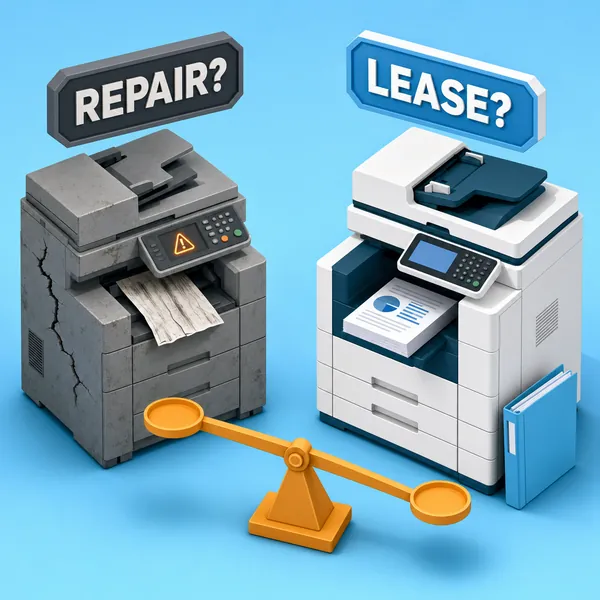
Transition to a rental with service included. This is where the honest repair-or-replace question comes in. I asked the print shop owner directly: does it make more sense to put a couple thousand dollars into aging machines, or pay a few hundred dollars a month for a maintenance-included lease on equipment that is not already in decline? Copy machines degrade very quickly at high volume. Sometimes the right answer is to stop repairing and start fresh.
For a machine where toner and parts have completely exhausted professional supply channels, the practical advice is simpler: run it until the toner is gone, then transition to a rental. Our short-term rentals include a service and supplies contract, cover both color and black-and-white, and do not require long-term commitments. There is no point putting repair money into a machine with no supply path.
One Thing to Know About Secondary-Market Parts and Toner
When professional supply channels come up empty, the natural next question is whether secondary marketplaces might have what you need. It is worth addressing directly.
When we checked every professional supplier we work with and found nothing, the customer asked the same thing. My honest answer: you might find a listing online. But availability and reliability through those channels are uncertain, and I would not build a production schedule around it.
The deeper issue is why this happens. Manufacturers phase out parts and supplies through planned obsolescence, the same way consumer electronics companies handle product cycles. The machine may still run. The supply chain behind it does not. A manufacturer needs to sell new machines, and an end-of-life declaration is how that transition happens. That is not cynicism; it is the business model. Understanding it helps you make a clear-eyed decision about whether to chase secondary-market toner or move on.
What to Do with the Old Machine
This is the question competitors skip, so we will answer it plainly.
Commercial-grade copier disposal is not free and it is not curbside. Getting a service to come pick up a commercial machine runs approximately $150 to $200. That cost falls to the business. We do not have an in-house disposal solution, and I will not pretend otherwise. There is no great answer here — it is a real cost you should factor into your transition planning.
Some LA County and City programs accept commercial office equipment through e-waste channels, though availability varies by jurisdiction and those programs change. It is worth checking with your local municipality before you default to a paid pickup service.
Aging Off a Contract Does Not Have to Be a Crisis
If you find out about the end of your manufacturer coverage before the machine fails, you have time to make a good decision. That window is where the options are. Once the machine is down and you are calling around for parts that do not exist, the choices narrow fast.
The path forward usually looks like one of two things: a third-party maintenance agreement that takes over where the OEM left off, if the equipment is worth servicing and the ROI supports it, or a transition to a rental with service and supplies built in when the math on repair no longer makes sense.
We give free estimates, and we evaluate equipment before committing to a service agreement. If you are not sure whether your machine is worth keeping under contract or whether it is time to make a move, that is exactly the conversation we have every day. We serve Greater Los Angeles from our base in Van Nuys, covering the San Fernando Valley, Glendale, Santa Monica, Downtown Los Angeles, and beyond. Give us a call before the machine makes the decision for you.