August 11, 2026
Emergency Copier Service Response Time Los Angeles
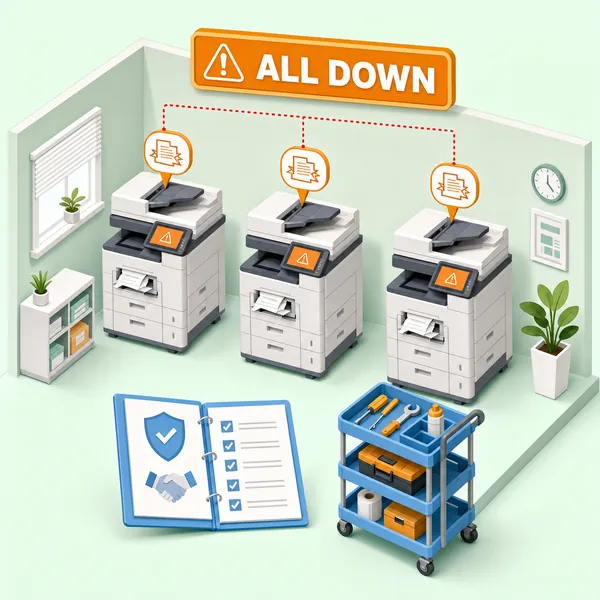
Your high-volume copier goes down at 8 a.m. on a Tuesday. You have a deadline. Your team is standing around. You call your service provider and get a ticket number and a promise of a response within four hours.
Four hours is a long time when your business runs through that machine.
For certain operations, a downed copier is not an inconvenience — it is a full stop. A law firm client put it plainly in a review: "Without DataPrint Solutions we would simply close the doors." That is not hyperbole. That is what mission-critical equipment uptime actually means. A West LA restaurant and catering company prints everything through their large Sharp: menus, meal labels, high-volume daily output. When something goes wrong, they need someone there right away. Not by end of day. Right away.
The industry standard response window most service providers advertise is four hours. That benchmark is widely cited, and for many businesses it may be acceptable. But there is a significant gap between a four-hour industry average and what a well-established local service relationship actually delivers — and that gap is measurable. For businesses in Los Angeles, emergency copier service response time is not an abstract metric. It is the difference between a productive morning and a lost one.
What a 3-Year Fleet Relationship Looks Like in Writing
The clearest evidence we have of what emergency copier service response time looks like in a real high-volume environment is not a marketing claim. It is a signed letter on company letterhead, dated March 11, 1997, from the Supervisor of Reprographics and Document Control at Lear Astronics Corporation, an aerospace and defense manufacturer.
At the time of writing, Lear Astronics had been a DataPrint client for more than three years. They maintained a fleet of over 20 machines across multiple brands: Mita, Copystar, Royal, Sharp, and Gestetner. That kind of multi-brand fleet, running in a manufacturing environment where document control is not optional, leaves no room for slow service. A single machine down in a department can stop production paperwork cold.
The department supervisor wrote specifically to praise the quick response time, and she called out the big machines in particular. The year prior, DataPrint had supplied a Gestetner 2460, a high-volume machine. That is the equipment where downtime risk runs highest. Those are the machines where a "we'll get someone out tomorrow" answer is not acceptable.
What stands out in that letter is not just the praise for speed. It is the language around trust: the client wrote that when she delegated a service request, she was confident it would be done right the first time, and that the technician would arrive with the parts needed to complete the repair. She described the fleet as crucial to their ability to conduct business as usual.
That is not the kind of confidence a client puts in writing after one or two good service calls. It is earned over years.
The Gap Between a 4-Hour Promise and a 1-Hour Reality
When a business reaches out to a national chain or a franchise operation, the call typically goes to a dispatch center. Someone logs a ticket, assigns a territory, and queues a technician. In Los Angeles, where traffic can turn a 10-mile drive into an hour-long commitment at the wrong time of day, that dispatch lag compounds quickly. A service window that might be manageable in a smaller market becomes a half-day problem here.
The experience that established DataPrint clients describe is different. A law firm that has worked with us for over 25 years noted a usual response time of no more than one hour. That is not a contractual guarantee — it is what a long-term local service relationship, with proximity and machine familiarity built up over years, actually produces.
When a machine goes down entirely and cannot wait for a repair, the response looks different still. One client received a replacement rental unit the same day their machine failed. As they put it: "I was surprised how fast the issue was resolved." Another customer reached out for a printer repair and had a technician on-site within two hours of the call, with the problem diagnosed and resolved in a single visit. That is same-day copier repair in Los Angeles the way it should work.
That kind of response is difficult for any provider to replicate through a call center. The person who answers your call at a national chain is not the person who will be in your office. At DataPrint, you reach the people who know your machines.
Parts on Hand: Why First-Visit Resolution Changes the Equation
Response time gets you a technician at your door. What happens after that depends on whether the technician arrived prepared.
A return visit means a second appointment, and in Los Angeles, that can mean another half day or more of downtime. The question to ask any service provider is not just how fast they can arrive — it is how often they complete the repair on that first visit.
The 1997 Lear Astronics letter made this point directly. The client did not simply trust that a technician would show up quickly. She trusted that the parts would be on hand to complete the repair on arrival. That trust was not assumed — it was built over more than three years of consistent service on a fleet covering multiple brands.
DataPrint has been servicing Canon, Ricoh, Konica Minolta, Kyocera, Sharp, Brother, HP, and Xerox equipment since 1988. Thirty-five years of working across those brands means familiarity with failure patterns, common wear parts, and what a machine of a given age and volume history is likely to need.
We also do remote diagnostics before dispatching. When a print shop reached out recently with a Xerox that had just faulted, the first step was to ask them to text a photo of the error code so we could run diagnostics before the visit. Arriving already knowing what you are dealing with is not a small thing. It is the difference between a one-visit fix and a parts-ordering delay.
What Long-Term Service Relationships Actually Deliver
A technician who has serviced your machines for years knows things that a first-time visit cannot reveal: the history of a particular unit, the patterns that precede a specific failure, the configuration choices that have worked for your workflow. That accumulated knowledge has real operational value.
One long-time client described it this way: DataPrint has handled all of their copy needs for over 20 years, and because the service has been responsive and attentive, their machines are always humming. That is the outcome of a relationship, not just a repair.
Part of what sustains those relationships is honest guidance. Matching the right machine to a workload matters as much as fixing one that has failed. When a business owner came to us with a high-volume color workload running through a Xerox AltaLink 8130, a departmental machine rated for about 12,000 pages a month, the right answer was not to keep servicing a machine being pushed far beyond its design limits. The right answer was to find a production-level replacement before the machine failed entirely under the load. We will also tell a client directly when a repair is not worth the cost. As one customer noted after asking for our recommendation: the cost comparison made it clear that a new machine was the answer, and that honest guidance is exactly what they needed.
A copier maintenance agreement with a well-established local provider also shapes response time expectations from the start. Clients with active maintenance agreements in Van Nuys and across the San Fernando Valley know what their copier maintenance agreement response time looks like before an emergency forces the question. We have been doing commercial-grade service, maintenance agreements, and equipment sales for approximately 35 years. The goal has never been to close a single transaction. The goal is to still be the call you make when something goes wrong five years from now.
What to Ask Before You Need Emergency Service
Most businesses do not think carefully about service response until a machine is already down. These questions are worth asking before that moment arrives.
Is the response time a guarantee or an average? The four-hour figure that appears across most service provider marketing is typically an industry average, not a contractual commitment. Understand what your agreement actually promises before you need to hold someone to it.
Does the technician arrive ready to repair, or do parts get ordered after the diagnosis? A same-day visit that ends with "we'll need to order a part" still leaves you without a working machine. Ask how often repairs are completed on the first visit and how parts availability is handled.
Will you reach someone who knows your equipment, or a dispatch queue? An owner-operated local copier service in Van Nuys means the person who answers your call is the person who diagnoses the problem. That is a meaningful difference when minutes matter.
Does your provider actually serve your part of Los Angeles? We serve the San Fernando Valley, West LA, South Bay, Downtown LA, Burbank, Glendale, Pasadena, Santa Monica, and Long Beach. In a city where traffic is a real variable, local proximity is not a minor detail. It is what makes a one-hour response possible in the first place.
The client letter from Lear Astronics is nearly 30 years old. The service model it describes, fast response on the machines that matter most, parts on hand, first-visit resolution, honest guidance, and a relationship built on trust over time, is the same service model DataPrint operates on today.
If you are in greater Los Angeles and you want to know what it looks like to work with a local provider before an emergency forces the question, reach out to DataPrint Solutions. We would rather hear from you now than after your machine has been down for half a day.