August 4, 2026
Copier Fleet Maintenance Los Angeles: An Aerospace Case Study
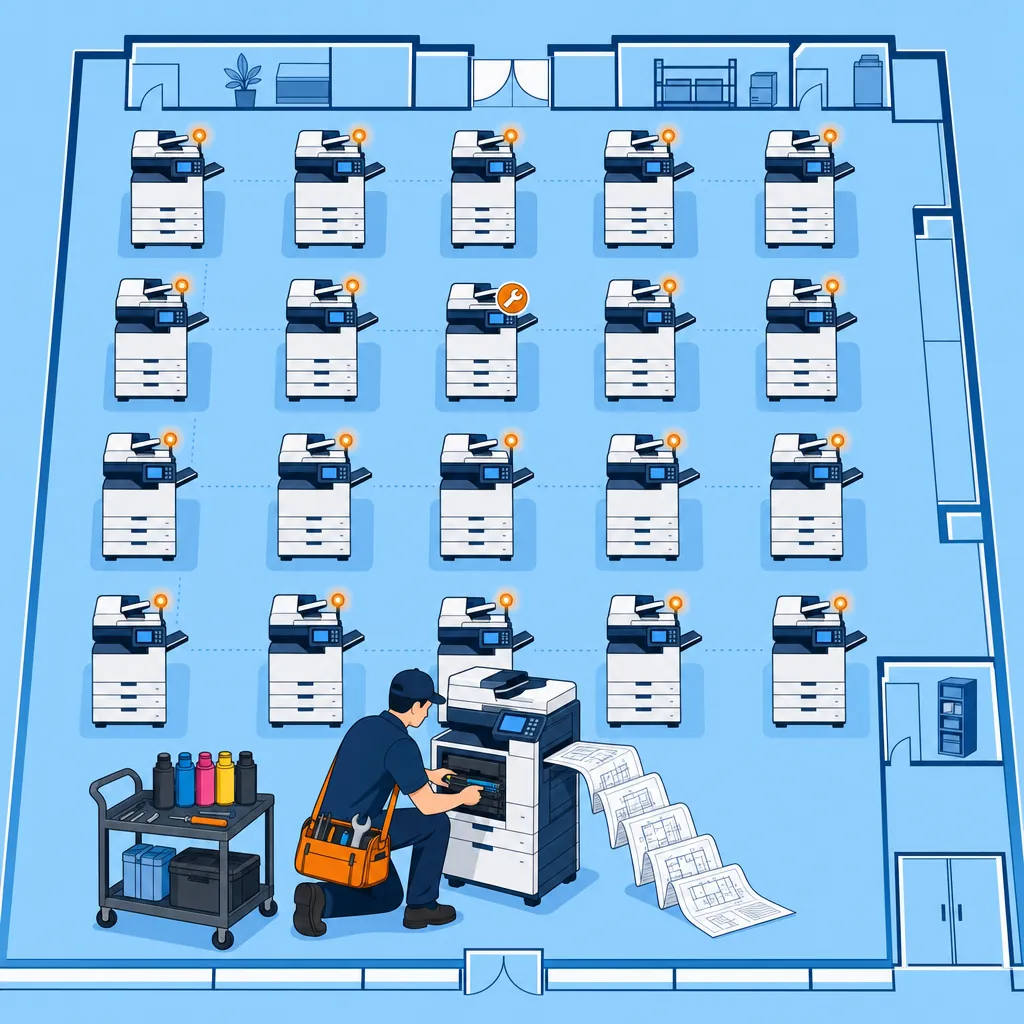
In a high-volume industrial environment, document production does not pause for a service ticket. Engineering drawings, quality control records, compliance paperwork — it all moves on a schedule. When one machine in a 20-machine fleet goes down during a critical production run, the only number that matters is how long until a technician is standing in front of it.
We have been answering that call in the Los Angeles area since 1988. And unlike most service providers you will vet during this process, we can point to documented evidence of doing it at scale: client correspondence from a multi-year service relationship with a large aerospace and defense manufacturer in the Los Angeles area, maintaining a 20+ machine mixed-brand fleet throughout.
That record is what this post is built on.
The Client and the Challenge
The client was a large aerospace and defense manufacturing operation in the Los Angeles area. Their fleet ran across multiple brands: Mita, Copystar, Royal, Sharp, and Gestetner equipment — more than 20 machines in total, spread across a production environment where uptime was not optional.
The fleet included a Gestetner 2460, a machine where a breakdown carries significant operational weight. A calendar-based service schedule is not adequate. Response time on a breakdown is not a preference — it is an operational dependency.
In aerospace and defense environments generally, document output supports production workflow, quality records, and regulatory compliance. Print capacity is infrastructure, not office equipment. DataPrint served as the primary service provider across this full mixed-brand fleet for more than three years.
What Copier Fleet Maintenance Actually Looks Like at Scale
The standard industry approach to copier maintenance is calendar-based: a technician comes out every six months, checks what they can check, and leaves. That model does not hold up well across a high-volume multi-machine environment.
Our approach ties maintenance to page count rather than a fixed schedule. We call it "unscheduled scheduled maintenance" — the timing is not arbitrary, but it tracks actual machine usage rather than a date on a calendar. At approximately 100,000 pages, periodic maintenance kits should be installed. We track meter counts and plan around them.
For a fleet maintenance agreement, we structure for roughly three planned service calls per year per machine. The goal of every planned call is to install the right components at the right interval so that unplanned emergency calls become the exception rather than the norm. That requires knowing what each machine actually needs, which is why we will not quote a maintenance contract without first coming on-site to evaluate machine condition and read the current meter count. Without that visit, there is no accurate basis for a quote.
Time on-site for a standard maintenance call runs 45 minutes to an hour. Extensive maintenance — full drum kit replacement, transfer belt service, paper feed rollers — runs one and a half to two hours per machine at most. Across a 20-machine fleet, those numbers matter for scheduling and budget planning.
Emergency Response on High-Volume Equipment
Planned maintenance keeps the fleet healthy. But the test of a service relationship is what happens when a critical machine goes down outside of any scheduled visit.
The client correspondence from the aerospace manufacturer specifically noted DataPrint's fast emergency response on the Gestetner 2460, the highest-volume machine in the fleet and the one where a breakdown carries the most operational weight. That praise was not incidental. It is what a demanding industrial client documents when a vendor has earned it.
Part of what makes that response possible is how we structure our scheduling. Contracted clients come first. When the calendar is full and a new service request comes in, our contracted relationships get priority. We are straightforward with new clients about this, because it is the same policy they will benefit from once the contract is in place.
That priority structure has produced response times that long-term clients notice. As one client of 25 years in the legal industry put it: "Their services is always very responsive, with a usual response time of no more than an hour." A separate long-term client whose primary machine failed unexpectedly described the same dynamic from the other direction: a replacement rental unit arrived and was operational the same day the breakdown occurred.
Those are not promotional claims. They are what clients say after years of depending on the service.
Trusted Equipment Recommendations — Not Just Repairs
A vendor fixes what breaks and invoices for the work. A service partner tells you what your equipment actually needs, including when the honest answer is that a repair is not worth the cost.
The client letters from the aerospace manufacturer noted that DataPrint was relied on for equipment recommendations across the full length of the relationship, not just for repairs. That kind of trust develops when a client learns that the advice they receive is straight.
Our position on repair versus replacement is consistent: if a repair is not economical, we say so directly. We will not bill for a losing repair to avoid an uncomfortable conversation, and we will not take a service call we do not believe we can resolve well. As one client put it after an on-site diagnostic led to a recommendation to replace rather than repair: "He clearly explained to me the cost of fixing vs. purchasing a new color printer. It became clear that a new machine was the answer." That client then asked for replacement recommendations, and our team followed up after the visit with a detailed written list.
The same principle applies to service calls where success is unlikely. We decline those calls. It protects the client's budget and it protects a reputation we have been building since 1988. For more on how to think through that decision, our post on when to repair or replace your printer walks through the key considerations.
Why a Local Owner-Operated Shop Outperforms a National Chain for Fleet Work
National chain vendors route service calls through centralized dispatch. The technician who arrives may have no prior knowledge of your specific machines, your account history, or the quirks of your environment. That structure is efficient at scale. It is not well-suited to a mixed-brand fleet in a demanding production setting where context matters.
DataPrint has operated continuously in Los Angeles since 1988. That is 35+ years of institutional knowledge of the LA market, the clients who operate here, and the equipment they run. When you call, you reach someone who knows the brands, knows the maintenance history of machines we have serviced before, and can make decisions without routing through a dispatch queue.
That direct relationship is not incidental to what we do. It is why clients stay. A law firm that has worked with us for 25 years put it plainly: "Without DataPrint Solutions we would simply close the doors." A client of more than 20 years described the practical outcome: "responsive and attentive so our machines are always humming."
Those relationships did not happen because a national chain dispatched a competent technician. They happened because the same team showed up, learned the equipment, and built a record of straight advice and reliable response over decades.
What This Means for Your LA Business Today
If you are managing a multi-machine environment in Greater Los Angeles and need a service partner with a documented enterprise-scale track record, the starting point is simple: a free on-site assessment.
We come to your location, evaluate each machine's condition, read the meter counts, and identify what the fleet actually requires. That assessment is what makes an accurate commercial copier maintenance agreement possible. We will not quote without it.
From there, two structures are available. An annual multi-machine copier service contract covers planned service at appropriate intervals — roughly three calls per year per machine — with components installed on a usage basis to minimize unplanned downtime. Time-and-material copier repair service is also available at $175 per hour with a one-hour minimum for clients who prefer that arrangement.
We service all major commercial brands relevant to a mixed-brand fleet: Sharp, Kyocera/CopyStar, Konica Minolta, Ricoh, and HP. Our service area covers Greater Los Angeles including the San Fernando Valley, Burbank, Glendale, West LA, South Bay, Downtown LA, Pasadena, Santa Monica, and Long Beach.
If your operation depends on print uptime and you need a partner with the track record to back that up, contact DataPrint Solutions to schedule your free on-site assessment.