November 23, 2026
Is It Cheaper to Buy or Lease a Copier?
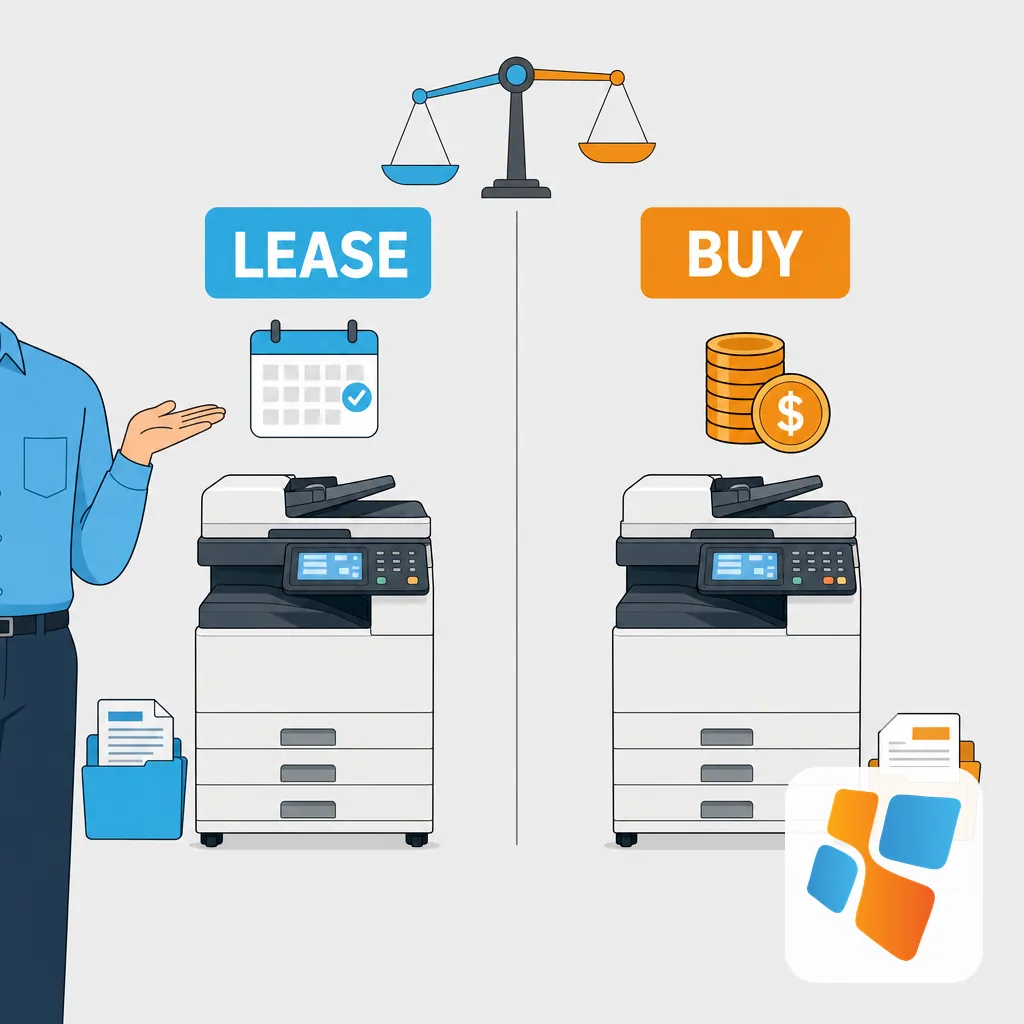
You need a copier. You have three weeks, or three months, or a new office and no print history to work from. Someone hands you a lease agreement with a 48-month term and a monthly number that looks reasonable — until you read the fine print. Most articles will tell you it comes down to buy versus lease. That framing leaves out the option that often makes the most sense, especially for a business that is still figuring out what it actually needs.
We have been helping Los Angeles businesses work through exactly this decision since 1988. The right answer is almost never the same twice, and it always starts with one question that most people forget to ask.
The Question Nobody Asks First: How Much Will You Actually Print?
Volume is the variable that determines everything else. Size a machine too small and you are paying overage charges or waiting on a slow drum every afternoon. Size it too large and you are locked into a monthly payment built for a print operation you never became.
A business opening in three weeks with 70 students and a projected growth to 300 cannot size a lease correctly. There is no data to work from. That is not a flaw in the planning — it is just the reality of a startup phase, and it is exactly the situation a tutoring center owner described when they contacted us recently.
Our recommendation in that conversation was straightforward: start with a rental. Build a few months of real usage data first, then decide on a lease. Schools and educational programs that assume they are light-volume users often discover, once they are fully operational, that they are running 20,000 to 40,000 pages a month. That number changes what machine you need, what contract makes sense, and what monthly cost is reasonable.
Is It Cheaper to Buy or Lease a Copier in LA?
Purchasing a commercial-grade multifunction copier outright typically runs between $3,000 and $15,000 depending on speed, color capability, and volume capacity. That number gets a lot of attention because it is large. What gets less attention is everything that comes after it.
Toner, service contracts, drums, and general supplies add up. Over five years, the total cost of owning a commercial copier is commonly 30 to 50 percent higher than the purchase price. That gap does not mean buying is the wrong call — it means the sticker price is not the whole story.
Buying can be the most cost-effective path when you keep the machine for five or more years and your volume is stable throughout. Those are real conditions, not guaranteed ones. Tax treatment of purchased equipment, Section 179 deductions and depreciation schedules, can also shift the math in your favor, but that is a conversation to have with your accountant, not your copier vendor.
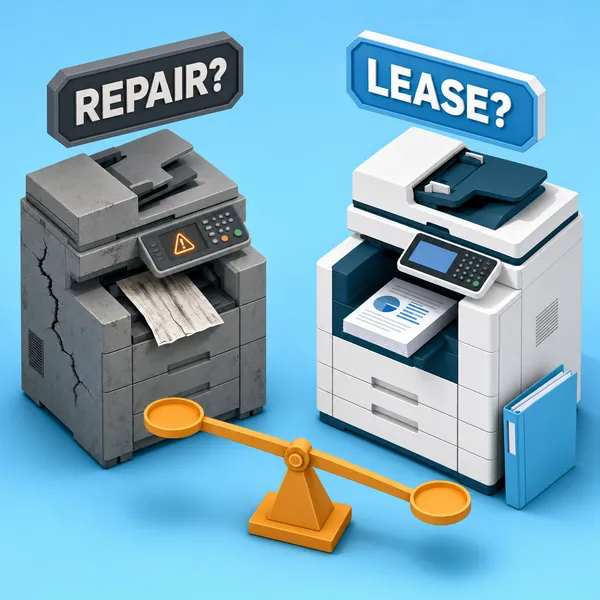
One other thing buying creates is exposure to aging-equipment decisions. When the cost of a single service call approaches what it would cost to replace the machine, a repair no longer makes financial sense. We run into this with consumer-grade printers fairly often — our on-site minimum is $175, and there are machines where that rate is close to the replacement cost. In those situations, we tell people directly: it is not worth the service call. The same logic applies to any owned commercial machine past its useful life. Ownership means those decisions land on you. If you are weighing whether to repair or replace your printer, that decision framework matters before you commit to any acquisition path.
Leasing a Copier: What the Monthly Number Doesn't Show You
A copier lease is a financing arrangement. You are not buying the machine — a third-party leasing company owns it, and you pay to use it over a fixed term, typically 36 to 60 months. The monthly number quoted upfront is real, but it is not the complete picture.
For a mid-volume color multifunction copier, most small and mid-sized businesses pay somewhere between $150 and $400 per month on a standard lease. What that payment may or may not include depends on the contract. Service and supplies are often separate. Overage charges kick in when you exceed the page allowance built into the agreement. Some leases carry escalation clauses that allow the monthly payment to increase over time. Automatic renewal provisions can extend the term if you do not provide written notice by a specific deadline.
One detail that surfaces less often: many leasing companies require you to name them as a loss payee on your business property insurance, which is the coverage that protects the equipment itself rather than your general liability policy. If you do not have existing coverage that satisfies that requirement, you may be charged a monthly insurance surcharge. Ask your insurance provider and the leasing company about it before you sign.
Early termination on a standard lease typically means paying out the remaining balance. That is not a penalty buried in fine print — it is how leasing structures work. Going in with clear eyes about that term length and what it costs to exit early is the most important thing a business owner can do before signing. Our post on copier maintenance agreement questions to ask before you sign covers similar contract scrutiny that applies here.
Renting a Copier: The Option Most Articles Skip
Rental and leasing are not the same thing. Most articles treat them as interchangeable. They are not.
A lease is a multi-year financing commitment with a third-party lessor. A rental is a shorter, more flexible arrangement directly with the equipment provider, with service built in. For businesses in a growth or uncertainty phase — and for anyone asking should I rent or lease a copier for a new business — rental is often the right starting point.
Here is what a rental from us actually looks like. Our entry-level rental is $175 per month for an A3 color multifunction copier. That machine handles letter, legal, and ledger-size paper, has four paper drawers, an inner stapling finisher for pre-collated and stapled packets, and scans to email and network folders. All supplies are included, along with 5,000 black pages per quarter.
Rentals are billed quarterly in advance. The first payment of $525 initiates the first three months. There is a separate $175 delivery fee that covers both drop-off and pickup at the end of the rental period. We ask for an annual commitment, not a multi-year lock-in, and if your volume grows to the point where a higher-capacity machine makes more sense, you can upgrade into one. That conversation typically happens around nine months in, once real usage patterns are clear.
The other thing that makes a rental relationship different from simply borrowing a machine: our equipment automatically submits meter readings. That means we know what is coming before you do. We can schedule service proactively rather than waiting for a breakdown to prompt a call. As one long-time client described it, our team is "responsive and attentive so our machines are always humming." That does not happen by accident — it happens because we are watching the data.
Side-by-Side: Which Path Fits Which LA Business
There is no universal right answer here, but there is a practical guide based on where a business actually is.
Start with rental if you are a new business, a growing operation, or any situation where your monthly print volume is genuinely unknown. The tutoring center scenario described above is a clean example: projected volume ranged from 70 to 300 students, with no established page count to anchor a lease decision. A rental at $175 per month generates real usage data without locking in a 48-month commitment based on a guess. This is the most common answer when people ask how much does it cost to rent a copier per month: $175 is a real starting point for a capable A3 color machine with service included.
Move to a lease or purchase if you are an established operation with stable, predictable volume and years of print history to work from. A law office that has been printing trial prep materials for two decades knows exactly what it needs. A restaurant printing menus, catering packets, and daily operational documents knows what it runs through every month. These are businesses where the numbers support a multi-year commitment and the economics of leasing or buying can be evaluated with confidence. We have served clients in exactly this category — legal and professional services firms across the Los Angeles area — for 20 and in some cases 25 years.
Neither path makes sense when the machine in question is not commercial grade to begin with. We get calls occasionally about consumer printers that have stopped working. When the cost of a service visit approaches what it costs to replace the unit, we say so and point the caller toward a retailer. Honest repair-versus-replace guidance is part of what a local provider with 35 years of experience brings to the table. A national chain or a call center has no incentive to tell you that a repair is not worth it.
What to Ask Any Copier Provider Before You Sign
Whatever path you choose — and whether you are comparing copier rental vs lease in Los Angeles or deciding between a lease and an outright purchase — these are the questions worth asking before you commit.
- What is the per-page overage rate once you exceed the included page allowance?
- Is there an escalation clause that allows the monthly payment to increase during the term?
- What are the early termination terms, and what does it actually cost to exit?
- Is maintenance included, or is it billed separately when service is needed?
- What happens at the end of the term — do you own the machine, return it, or renew?
- Are delivery, setup, and pickup included in the quoted price, or billed separately?
That last question matters more than it sounds. Our rental pricing is clear on it: $175 delivery covers both drop-off and the eventual pickup. No surprise charge at the end. Not every provider structures it that way.
We provide all-in pricing upfront. Monthly rate, delivery fee, page allowance, quarterly payment structure — all of it stated before anything is signed, with full details sent in writing afterward. That is the standard to hold any provider to.
The right acquisition path depends entirely on where your business is right now: how established your volume is, how long you plan to stay in the same configuration, and how much flexibility you need to preserve. A generic pros-and-cons list does not answer that. A conversation with someone who has been doing this in Los Angeles since 1988 usually does.
If you are working through this decision, call or email us. You will get a straight answer, not a sales pitch.